
Strategy Guide
Strategic Plan From a Current Attending: Obtaining a J1 Waiver Position Through Conrad 30 Programs
There are plenty of valuable resources available online if you are willing to dig through them. This guidance is written by a current attending who went through the J1 waiver process and is sharing the exact strategy that worked.
Written March 12, 2026.
It is, however, a time-consuming and sometimes confusing process. I would also love to share the resources and strategy I used, which helped me to easily land a J1 waiver job. I will help you understand how the process works, give you do’s and don’ts, and tell you how I used this database which will serve you well on the journey. I will also break some misconceptions along the way. It is a stressful process but I am sure you will land a J1 waiver job because you have worked hard to get to where you are and because you deserve it!
This guide is designed as a practical, step-by-step roadmap for Conrad 30 applicants and shows exactly where our data can accelerate your search and reduce dead ends.
Important: Immigration rules and state criteria change. Use this guide for education only and consult an immigration attorney for personal legal advice.
- What is J1 waiver?
- Can you avoid the J1 waiver?
- What J1 waiver programs are out there?
- The step-by-step strategy...
- Why should you wisely pick a state...
- What is my strategy of picking the states?
- How do I know if the hospital will sponsor?
- 5 big misconceptions
What is J1 waiver?
J waivers are available for those physicians who agree to work in Health Professional Shortage Areas (HPSAs) or Medically Underserved Areas (MUAs) for a minimum of 3 years. Generally, International Medical Graduates who do medical residency and fellowship programs on J1 visas in the U.S. must return to their home countries for 2 years after completing their programs, unless they receive J1 waivers. This rule applies to you if the box “Subject to two-year residence requirement” is checked off on your DS2019. Even physicians who marry a US Citizen cannot obtain a green card without either a waiver, or satisfying the 2-year requirement.
Can you avoid the J1 waiver? Yes!
Before we jump into talking about the J1 waiver, you must know that you have other options if you want to stay in the US before getting a J1 waiver job. Please consult a lawyer for the specific requirements and your eligibility.
- Hardship waivers can be granted to J-1 physicians who can demonstrate that a US citizen or lawful permanent resident spouse and/or child would suffer “exceptional hardship” if he were forced to return to his/her home country for 2 years.
- J-1 physician of extraordinary ability may apply for an O-1 visa without having to get a J waiver. However, the J-1 physician is not permitted to change his status from J-1 to O-1 in the US. The O-1 visa may be valid for an initial period of three years and may be extended indefinitely in one-year increments. If the physician only works on an O-1 visa without doing their waiver, he/she cannot apply for permanent residency in the U.S.
What J1 waiver programs are out there? Conrad 30 program is just one of them!
There are several programs through which you can obtain your J1 waiver job. They are:
- Conrad 30 state programs
- HHS Exchange Visitor (J-1) Waiver Program for Physicians
- J1 Visa At The Veterans Administration
- Appalachian Regional Commission J1 Waiver Program
- Delta Regional Authority J1 Waiver Program
What is my strategy of finding a J1 waiver job through Conrad 30?
Step 1: Lock down the states that you want to move to. Obviously, making such a list is a personal decision as you would be spending 3 years at that location. I would advise you keeping an open mind for other geographic locations, as the number of jobs that are available to you are truly limited due to your J1 visa status. However, one should be positive that even with geographic constraints you can end up finding a job in your desired or preferred location – for that, you have to know your options! Our website gives you a good starting point.
Step 2: Look through the states’ Conrad 30 rules and based on their criteria make a list of states you actually want to apply to. This is the homework we, visa holders, have to do. For some states the odds of getting a waiver job is much smaller than for others. It does not matter if you get a good offer from a hospital or not, sometimes they can only promise to give you a contract and submit your application to the state’s Conrad 30 office. You still have to get the spot from the state otherwise the contract is not valid. Choose your states wisely. I will talk about the strategy later in this article.
Step 3: Look through our website and know what private practice groups or academic centers have sponsored J1 waiver positions in the states of your choice. At this point, you should get an idea about the J1 waiver landscape in that particular state. Remember, each state has its own Conrad 30 rules, some states are more desired than the others (for example, the ones on the coast), and some states have more IMGs graduating than others. Each state gets their fair share of 30 spots. Therefore, the landscape is supposed to vary across the states. Do not be surprised if a tertiary center with great reputation in one state can sponsor J1 waiver while its counterpart in another state does not sponsor.
Step 4: Search for jobs on other websites. The websites I have used include: Gaswork (for anesthesia), Practice Link, Practice Match, Merritt Hawkins, Comphealth. I can write another article about my comments on each website. I think they all worth looking at. On some websites you can filter the jobs by visa sponsorship. Please know that some employers or recruiters who post the ads do not even know if they can sponsor certain types of visa. Do not filter them out if they did not specify their visa sponsorship. If you resolutely/rigidly/uncompromisingly deadly want to stay at one hospital or one area - ask if they are hiring and if they are sponsoring J1 waiver positions. Be proactive and be frank. Many places are hiring but they do not post their jobs online. How do we know if the hospital I am interested sponsor J1 waiver or not? I will talk about it later.
Step 5: Send CVs and cover letters to the hospitals or groups that you are interested. You can do it directly or through recruiters. Please use your connections!
Step 6: Go through the interview process. For anesthesia there are usually three steps. You talk to a recruiter to know what they offer, then you talk to the chair on the phone to briefly access fit, and then you interview with other faculty members during a formal interview day online or in person. Some places now give offers after online interviews without onsite visit. You can always demand an onsite visit to know more about the place. It is a reasonable request and the hospital should pay for your expenses. You will be spending the next 3 years of your life in that place, it is always good to go in person.
Step 7: Get offers, negotiate and pick the offer to sign! Please believe that even through you need visa sponsorship, you are still at a position of strength to negotiate. In general there are more room for negotiation at private practices than academic places when it comes to salaries. Please use our website for your references. You will be surprised by the number they offer initially and the number they are willing to pay!
Wisely Pick A State To Apply
First of all, you need to understand the Conrad 30 rules at the states you are interested in. This website has a very good summary (http://conrad30.com/). For updates and details, please google “Conrad 30 + state” which will direct you to the official website. The rules are different in several major ways. Here are the things that you absolutely need to know.
- How do they review the applications? Some states apply a score system (MA), some states do lotteries (CT).
- What’s the deadline for applications? For some it is first come first serve, until it is filled; some has a solid deadline (like NY, in Dec), and they won’t start review until after the deadline and all the applications are in regardless of their application time.
- When does the result come out? For some states you know it quickly (e.g. CT - Nov), for some it takes several months of review and the result do not come out until March/April (e.g. MA).
- Do they prioritize primary care over specialists? For example, in CT everyone has a fair shot at the lottery regardless of their specialty. For lots of states, there are limited spots for specialists each year. For some, they won’t review applications for specialists until several months into the application season (CA).
- What’s the competitiveness? This is another major factor that you have to consider before you pick your state. For example, NY, PA, TX, IL, FL and MA filled their spots almost every single year, earlier or later. On the other hand, Hawaii, Oregon, Alaska, etc. always have spots all year long. The best place to get the information is this website (https://www.irvine-legal.com/irvine-articles/tag/Conrad+30). Note: that resource appears to have updates through 2022, so use it to understand historical patterns and which states were commonly used. We refreshed this section and also checked other sources (including 3RNET) to cross-reference trends. If you pull all the information together from the last few years, you will have a pretty good idea about the competitiveness of each state. Please understand that high competitiveness indicates nothing about a good job offer. We will talk about it later. Competitiveness only indicates how easily you can get a spot from the state AFTER you sign a job offer. For each state, the number of applications they receive also varies by year. It is almost like stock market - Higher number of applications last year probably indicates less applications next year and the number will come back up the year after.
My Strategy of Picking the States
I actually divided the states in three categories by their rules and competitiveness, and picked one state at each category.
- Category one: First come, first serve, competitive, and results usually come out early
- Category two: Competitive, however, it has a late deadline
- Category three: Low competitiveness, and historically they have spots left all year long
There is an unwritten rule that you cannot apply to two states at the same time. If you are granted spots from two or more states, that would be a problem. You can only apply to two states at the same time if you sign a contract with two hospitals, which does not sound right in the first place. However, you have to have backup plan if one state passes you. The plan that I had in mind was to pick a state in category one as my first choice, a state in category two as the backup plan and a state in category three as the secondary backup.
Let me explain with examples. If you pick CT in category one, you can apply before Sep, and wait until Nov for the results to come out. If you do not get a spot in CT, you would still have time to sign a contract with a hospital in a secondary category state (e.g. MA) and apply for a waiver spot in that state. The deadline is Dec for MA, and the results come out next year April. If the category two hospital passes you, you could sign a contract with a hospital in a category three state. Hopefully by April, the category three hospital of your choice still has spots left.
You can pick any state you like in each category. If you are not interested in any state in category one, you can go straight to category two, knowing that by the time the result comes out, all spots in the states in category one would be filled already. You can also go straight to category three. This would give you a peace of mind in not having to worry about whether you get a spot in the competitive states and you can usually find great states and hospitals still.
How Do I Know If The Hospital Will Sponsor J1 Waiver?
There are actually many ways to find visa sponsorship info before you ask. However, assume they do not until they say yes to your inquiry!
- Look through our website and use the historical data! If they have sponsored, most likely they will!
- Look through the job posting website - visa sponsorship info is posted sometimes. If not, you can ask the recruiters.
- Search the hospital with its address on official HRSA website: https://data.hrsa.gov/tools/shortage-area/mua-find. Please know that being located the under-served area does not necessarily mean that they can sponsor.
- Send your CV and ask directly.
How Our Data Fits This Process
- Use our database right after you shortlist states to identify hospitals with real sponsorship history.
- Focus your outreach on proven sponsors in your specialty: Anesthesiology, Internal Medicine, Pediatrics.
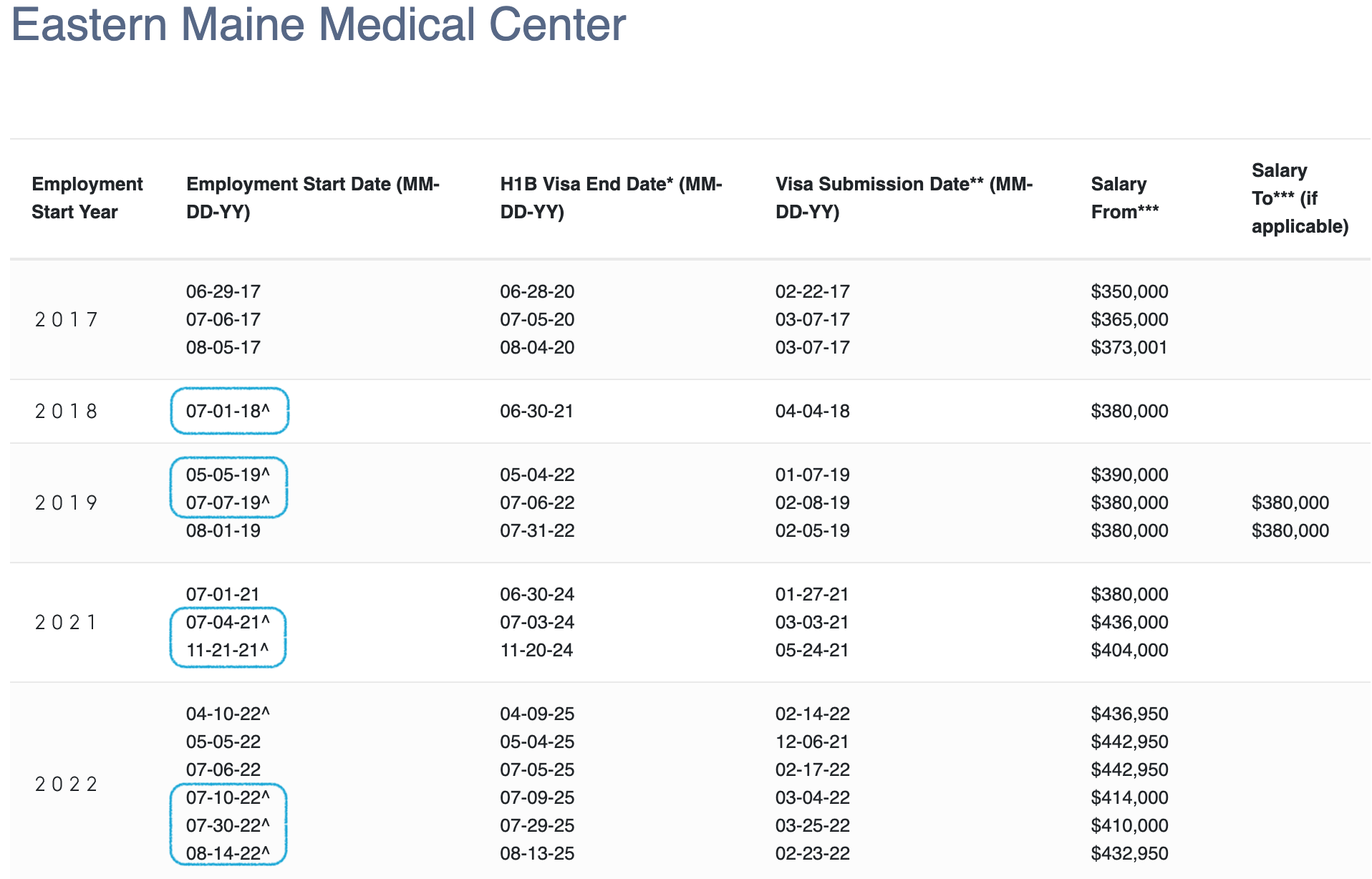
Example 1,
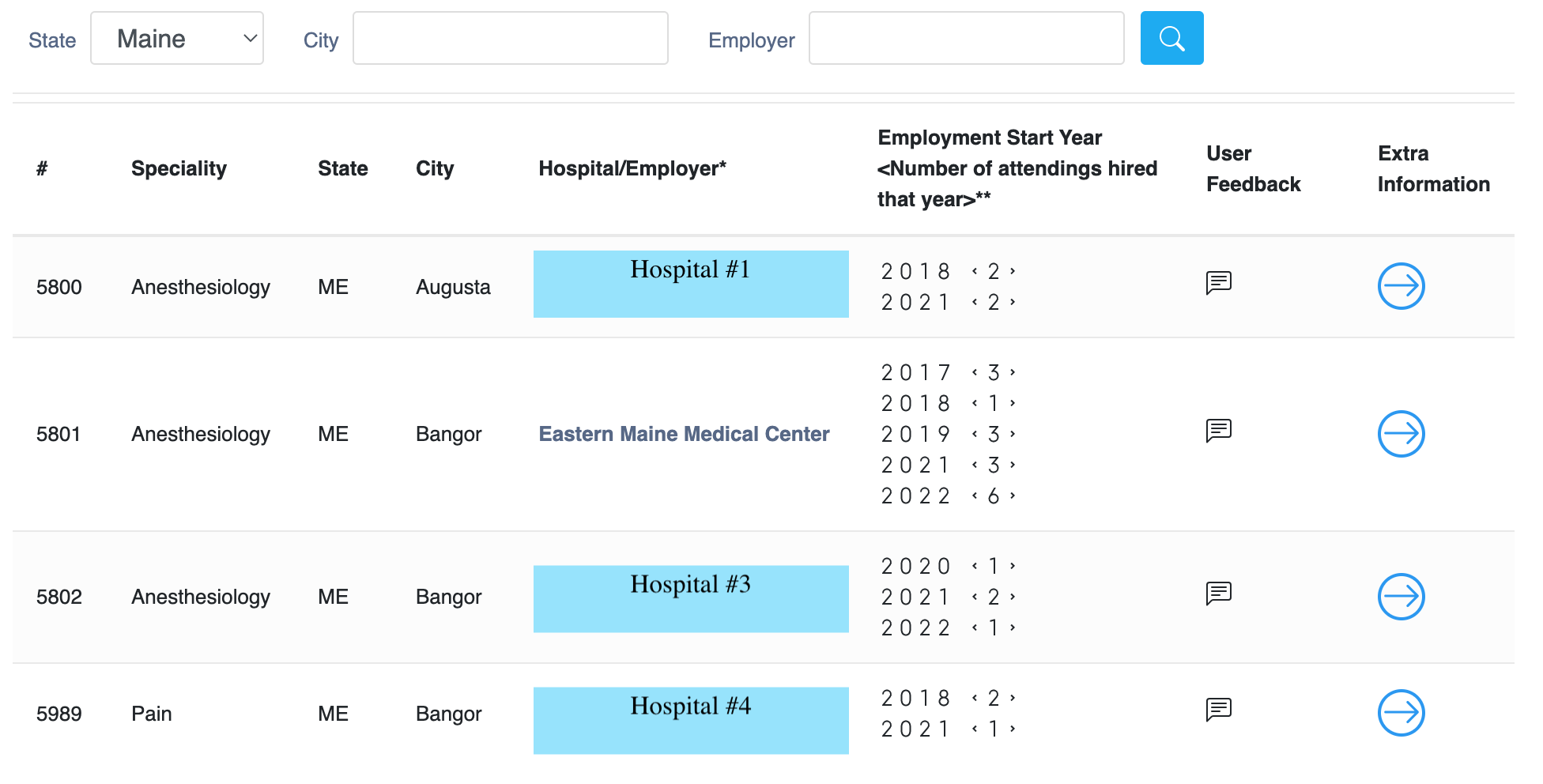
Looking at the detailed view above, we can make certain conclusions:
- 2018 – one visa-sponsored position without * with a February start date. Probably NOT a J-1 waiver positions.
- 2020 – one visa-sponsored position with * with a July 1st start date. Both the * is there and the position starts in July (right after residency/fellowship ends), indicating that this is probably a J-1 waiver position.
- 2021 – same as 2020!
- 2022 – One positions starting in May with * (could be a J-1 waiver though a bit early)
- 2022 – two positions starting Aug 1st with *. Please note, once you end your residency/fellowship on a J-1 visa, you have 30 days of legal stay in the country. Someone finishing end of June and taking a month means they’d start end of July/beginning of August. You can also travel and then you can start later. This two also seem like J-1 waiver positions.
Based on multiple positions in multiple years, I would conclude that this employer supports visa sponsorship at the least, and that they probably have experience supporting J-1 waiver physicians.
Example 2,
- Both in 2019 and 2022, there is one-one a new attending who started on a visa in July. Time-wise, these could be J-1 waiver positions, however, none of these have the ^ symbol.
- No ^ means these attendings had their visa before they started the above mentioned employment, thus these are most likely not J-1 waiver positions.
Here are the five big misconceptions.
- “If they sponsor J1 waiver historically they definitely sponsor again.” No! The departmental leadership decides whether they WANT to sponsor or not. They can but they may not want to. A new chair indicates new opportunities or loss of opportunities. Please read our instructions on how to interpret the data appropriately.
- “The chair wants to hire me and told me they can sponsor the waiver”. Good news, but still long way to go! Even though your chair is set on hiring you, they still have to fight for you. In some occasions, one hospital can only sponsor three employees per year. Three spots for employees in all specialties. If the hospital decides your department is not as much in need of an employee as other department(s), they may not let you sign the contract no matter how much the department chair advocates for you.
- “If they are located in the under-served area they can sponsor”. No! Again, not that simple. They may not meet the state criteria despite being located in the under-served area. In many occasions, like I mentioned before, they may not WANT to.
- “The hospital is located in a beautiful big city and it cannot sponsor”. Do not let go of the great opportunities because of this misconception. The hospital may not be located in the underserved area, however, they can meet the state criteria in many other ways. For example, some tertiary centers serve under-served populations across the state so that they meet the state criteria and they can actually sponsor! This is especially true for states where they have one giant state hospital without many competitors in the city.
- “The hospital is in a low competitive state from a waiver application standpoint. I can consider signing the contract later.” No! As I mentioned before, the hospital may only have three spots. If the hospital is highly desirable, the three spots will be reserved quickly. Even if you are not concerned about getting a spot in the state, be concerned with the availability at the hospital or the department. The hospital or the department is hiring all year long, both those on visas and those who do not need a visa.
Hope this can help. We wish you best of luck!
Please contact us if you have questions.
We would be delighted to hear your story of success!